
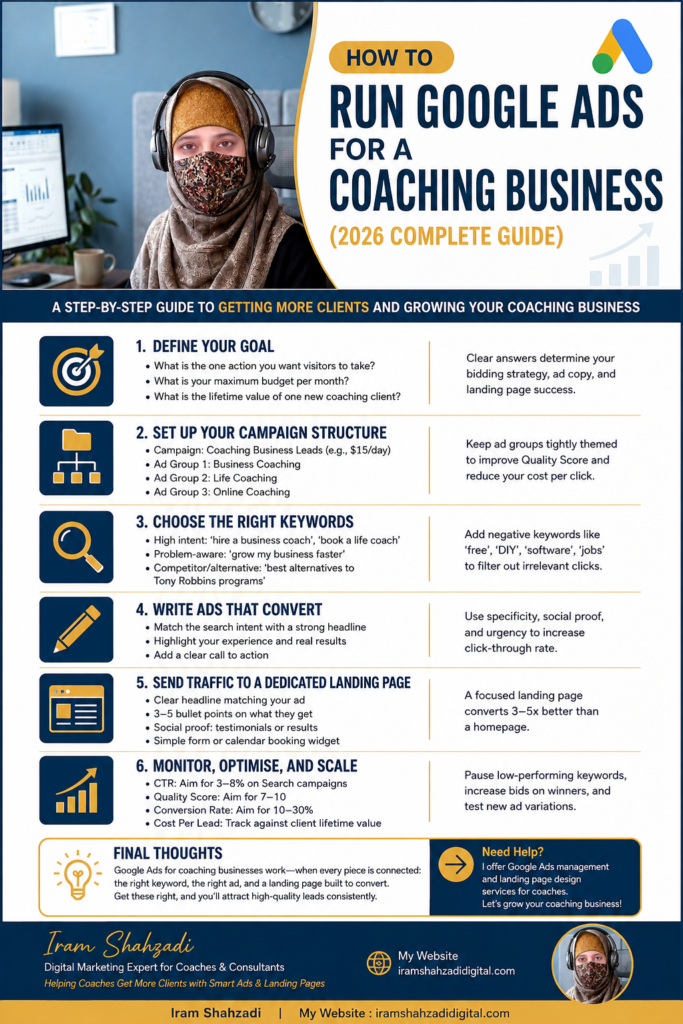
How to Run Google Ads for a Coaching Business (2026 Complete Guide)
Running Google Ads for a coaching business can feel overwhelming — especially when every click costs money, and you’re not sure if it’s actually working. I’ve managed Google Ads for multiple coaches and consultants, and in this guide, I’ll walk you through exactly how to set up campaigns that generate real leads, not just traffic.
Why Google Ads Work Especially Well for Coaches
When someone types ‘life coach near me’ or ‘business coach for entrepreneurs’ into Google, they are actively looking to hire someone. That’s the beauty of search advertising — you’re not interrupting people, you’re showing up exactly when they’re ready to take action.
Compare that to social media ads, where you’re showing your offer to people who might be vaguely interested. Google Search Ads catch people in decision mode, which is why they tend to generate higher-quality leads for coaching businesses.
Why Google Ads Work Especially Well for Coaches
Step 1: Define Your Goal Before You Touch Google Ads
Before creating a single campaign, answer these three questions:
• What is the one action you want visitors to take? (Book a call, sign up, download a lead magnet)
• What is your maximum budget per month? (Even $10/day can generate results in niche coaching markets)
• What is the lifetime value of one new coaching client? (If a client is worth $2,000, a $50 lead cost is excellent)
Having clear answers to these questions determines everything — your bidding strategy, your ad copy, and your landing page design.
Step 2: Set Up Your Campaign Structure
A well-structured Google Ads account looks like this:
• Campaign: Coaching Business Leads (set budget here — e.g., $15/day)
• Ad Group 1: Business Coaching (keywords like ‘business coach for entrepreneurs’)
• Ad Group 2: Life Coaching (keywords like ‘life coach for professionals’)
• Ad Group 3: Online Coaching (keywords like ‘online coaching programs’)
Keep each ad group tightly themed. This improves your Quality Score, which directly lowers your cost per click.
Step 3: Choose the Right Keywords
For a coaching business, focus on three types of keywords:
• High intent: ‘hire a business coach’, ‘book a life coach’, ‘business coaching services.’
• Problem-aware: ‘how to grow my business faster’, ‘overcome procrastination coaching.’
• Competitor/alternative: ‘best alternatives to Tony Robbins programs’ (advanced — use carefully)
Always add negative keywords to filter out irrelevant clicks. For a coaching business, typical negatives include: ‘free’, ‘DIY’, ‘software’, ‘jobs’, ‘career’. These stop you from paying for traffic that will never convert.
Step 4: Write Ads That Convert
A great Google Search Ad has three components: a headline that matches the searcher’s intent, a description that highlights your unique value, and a call to action. Here’s an example that works:
Headline 1: Business Coach for Entrepreneurs
Headline 2: 10+ Years Experience | Real Results
Headline 3: Book a Free Strategy Call Today
Description: Struggling to scale your business? I help entrepreneurs break through plateaus with proven marketing systems. Limited spots available.
Notice the specificity (’10+ years’), the social proof (‘proven systems’), and the urgency (‘limited spots’). All of these increase click-through rate without being misleading.
Step 5: Send Traffic to a Dedicated Landing Page — Not Your Homepage
This is the mistake I see most coaches make. They run ads but send traffic to their homepage, which has too many distractions. A dedicated landing page with a single call to action converts 3–5x better than a homepage.
Your landing page should include:
• A clear headline matching your ad (e.g., ‘Book a Free Business Strategy Call’)
• 3–5 bullet points explaining what the prospect gets from the call
• Social proof: testimonials, logos, or results from past clients
• A simple form or calendar booking widget — nothing else
I’ve designed landing pages for coaching clients that converted at 28–34%. The key is removing friction and making the next step obvious.
Step 6: Monitor, Optimise, and Scale
Once your campaign is live, check it daily for the first two weeks. Key metrics to watch:
• CTR (Click-Through Rate): Aim for 3–8% on Search campaigns
• Quality Score: Aim for 7–10 — low scores mean higher costs
• Conversion Rate: Aim for 10–30% on your landing page
• Cost Per Lead: Track this against your client lifetime value
After two weeks, pause keywords with zero conversions, increase bids on high-converting keywords, and test a second ad variation.
Final Thoughts
Google Ads for coaching businesses work — but only when every piece is connected: the right keyword, the right ad, and a landing page built to convert. If you’ve been running ads and not seeing results, the problem is usually in one of those three areas.
I offer Google Ads management and landing page design services specifically for coaches and consultants. If you’d like a free audit of your current campaigns or a strategy session to build a new one, get in touch here.